Private
Twin
The work moves forward. The state of the project should move with it.
Private Twin brings expected work close to observed execution, to rebuild a current state that is sourced and correctable: what changed, which decisions were made, who carries the next step, what is blocked, and which deadlines are about to slip. It does this without constant chasing or extra reporting.
 Inspect
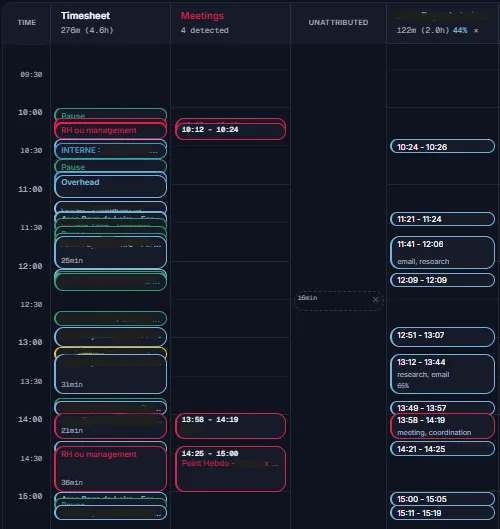
 From the day’s traces, Private Twin rebuilds a timeline of the work and attributes it to the relevant projects. Periods that remain uncertain stay visible as such.
problem
Picture several people and several agents working in parallel on the same files. A decision is made in a meeting, an agent takes an action, a deadline moves inside a tool, a trade-off arrives by email. Yet no shared representation of the work is updated. Everyone acts on a partial version of the situation.
The problem is no longer only finding information. It is knowing what is true right now, what has been done, what is still expected, who carries the next step, and what an agent may commit to without a fresh human check.
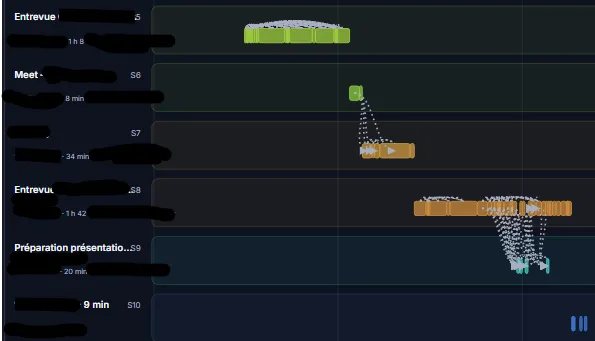
Private Twin rebuilds the thread of the day and connects the events that belong to the same sequences of work.
Prototype screenshot
 Inspect
 From the pyramid to the value-creation network
AI does not only change how tasks get done. It can also change how an organisation coordinates itself.
Today, a large share of intermediate work goes into searching for information, rebuilding the state of projects, preparing readouts and multiplying synchronisation meetings. When people and agents share a common context that is explainable and current, part of that coordination can be carried by the system.
Pyramid organisation
Information travels up through reporting; decisions and instructions travel back down through the layers.
Shared context
Explainable and governed: access rights, traced decisions, checkpoints.
Network of people and agents
Connected around projects, skills, dependencies and value-creation flows. Useful context circulates without crossing every layer.
The project starts by rebuilding the thread of one person’s work and the state of their projects. In the medium term, those validated and governed contexts could let colleagues, managers and agents share what they need without multiplying status requests, reporting and coordination meetings.
The system can absorb part of the information searching, the state rebuilding and the reporting. A manager’s role then shifts from collecting and relaying information towards arbitration, supporting teams, and owning decisions.
Guardrail
Automate the mechanics of coordination without surveilling people or replacing human accountability.
to prototype
Six steps, from research to the field
The project did not start with development. It started with a problem I experienced as a manager.
Explore the problem
Reading the research on agentic AI and cognitive science, particularly human attention and the effects of fragmented work.
Frame the idea
Private Twin answers first a problem I run into myself as a manager: steering several projects involving many people, while information, decisions and actions stay scattered. In that situation, reliable and current visibility becomes critical to coordinate teams and anticipate risk.
Test the initial interest
Calls and video conversations with about ten people, to test the problem against their own day-to-day and check whether the subject held.
Build
More than a year building a complete prototype and an AI-assisted development method. I also built a harness, the technical frame that runs, checks and evaluates the agents. It is designed to keep language-model calls to the strict minimum and avoid dependence on a single provider.
over a year
Monitor and evaluate
Creating Sim Lab to keep a complete trace of every run, follow how responsibility is delegated between the human and the agents, replay scenarios and catch regressions. An agent’s flow is drawn like a production line: every trace becomes a checkpoint.
Deepen market validation In progress
The phase currently under way, across four families of knowledge workers: twenty interviews in total, comparing how intense the problem is, how acceptable capture feels and what follow-up actually happens. A survey will only be used if a specific question later needs sizing.
prototype holds
Reliable context, for people and for agents
Assistants, agents and the people working with them need a reliable execution state. Private Twin maintains that state so they can act without losing context, evidence or control.
The prototype rests today on six complementary building blocks:
 Inspect
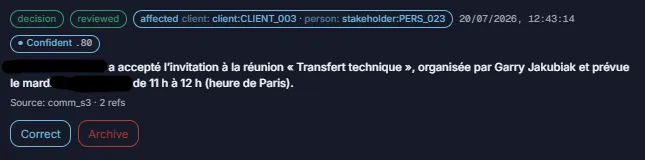
 A memory proposed from work traces, linked to the right people and carrying its sources. Validation stays with the user.
 Inspect
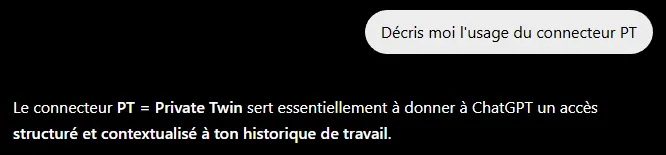
 The Private Twin connector makes the structured history of the work queryable from ChatGPT.
evidence
Checking that an agent behaves as intended
An agent that convinces over a handful of tries is not necessarily reliable over time. Sim Lab freezes a working day, replays it and compares versions.
Sim Lab can take a World snapshot: a complete, frozen photograph of a working day and of the system state at that moment. That World can then be duplicated to test several versions under exactly the same conditions, without touching the original day.
As on a production line, every step is a checkpoint. When a result degrades, Sim Lab helps pinpoint where and why the behaviour changed.
Snapshot
A day and the system state, frozen.
Duplication
The original World stays untouched.
Replay
Same scenarios, same conditions.
Comparison
Code, configuration, prompts or models.
Divergence
The first point where behaviour degrades.
 Inspect
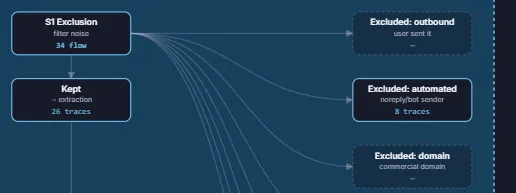
 In Sim Lab, every trace crosses checkpoints: what was kept, what was excluded and why all stay observable.
Prototype screenshot, extract of a flow
data
Keeping people and data under control
Three design principles, stated without promising anything beyond what is actually implemented.
Local-first by default
Work data and its context stay local by default. When an external model is used, what is sent is limited to what is necessary.
Deterministic first
Classic, deterministic processing is preferred wherever generative AI adds nothing. Language-model calls are reserved for the steps that need them, with the option to switch provider.
Proposals, not verdicts
What the system produces stays a proposal: the user can verify it, correct it or reject it. The point is to make work visible and understandable, never to score or monitor people.
status
An advanced prototype, still being tested against the field
Private Twin is presented as an advanced prototype under validation, not as a product whose market is already established.